Building Cladding, Truck Dumps & Transfer Points

Dust control for truck dumps and transfer points often involves both wind protection and agglomeration of the small particles. For agglomeration to work, the wetting agent (e.g. fog) needs to be contained enough to wet the dust. In addition, the treated material needs to finish in a place sheltered enough to minimize subsequent erosion of the quickly-drying wet fines. More information on this is on the Industrial Dust Control Page

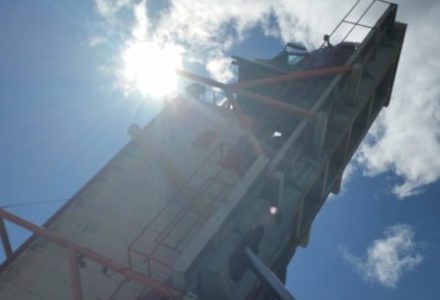
A tall industrial structure with orange supports against a partly cloudy sky
A tall industrial structure with red railings against a bright sky with the sun shining through clouds

Truck Dumps

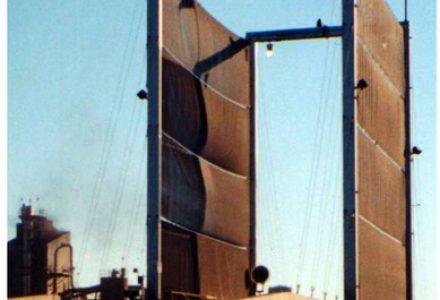
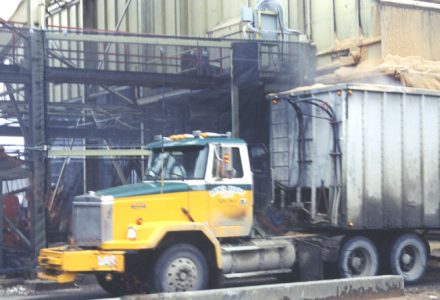
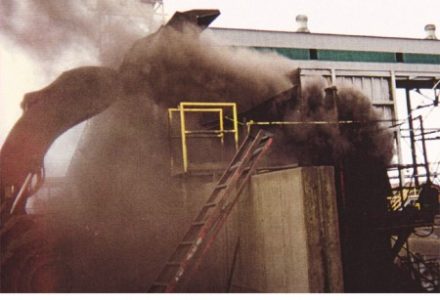
The photos below show 3 different styles of dump.

Tall portal frame fitted with dark fabric panels enclosing a truck dump
Bc burldumplg — Building Cladding, Truck Dumps & Transfer Points
A yellow and white truck is parked next to a large industrial building
A large industrial machine emits thick black smoke without any dust control measures in place
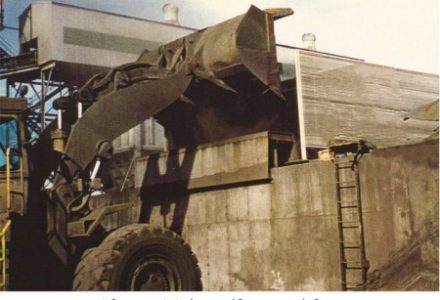
A large industrial loader pours material into a hopper with a wind fence and fog system in place

Building Cladding

Porous fabric is ideal for dust containment.

  • Can be adapted to fit most buildings
  • Allows natural ventilation
  • Allows natural lighting if translucent fabric is used – alternatively, control light levels with the light spectrum of fabric
  • Appreciably cheaper than most rigid cladding systems (the cladding is cheaper, and the load on building is less so it needs less support structure)

It can be attached using a clamp system, or using highly tensioned cables.

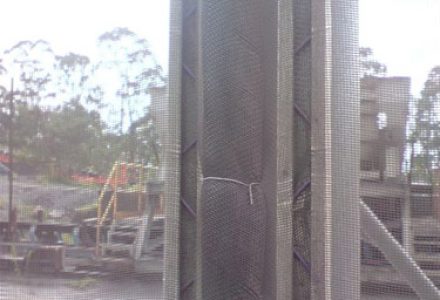
A large industrial structure with metal framing and mesh panels, possibly a wind fence or dust control system
Bc eld installation — Building Cladding, Truck Dumps & Transfer Points
A gloved hand touches a section of industrial fencing or netting outdoors

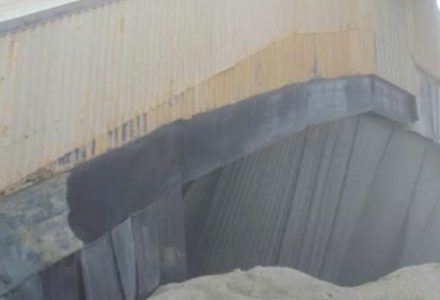
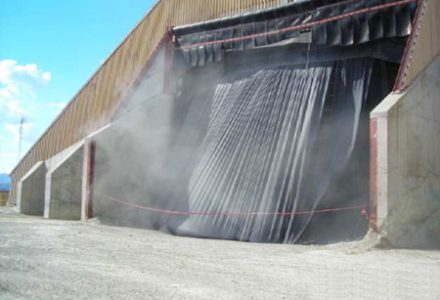
These are inter-linked curtains hanging from the roof over the open end and over the doorway of an A-frame building. They are anchored at the base. Note how effective it is considering dust literally spews out the side in one small area where they had not hung the curtains. The client was really impressed by how durable the fabric is. There’s a lot of crushed rock pushing out against the material (the pile behind the curtain is a good 20′ (6m) -25′ (7.6m) high!)

Corrugated metal siding with peeling paint and a dark patch, above a pile of light-colored material
A large industrial building with dust control curtains and a gravel ground
Industrial structure with conveyor belt amidst dirt mounds and mountainous backdrop

Installation

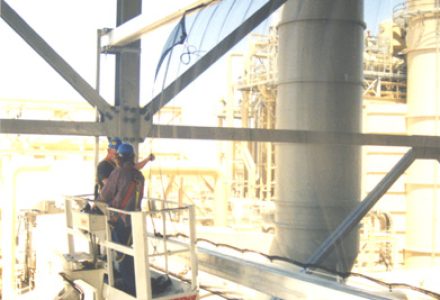
The installation is not complicated, however as with everything there is a learning curve. For example, hanging a panel of fabric (typically 12ft (3.6m)x 60ft(18m)) will take two to three hours for the first one – (2 or 3 man crew) and 45 minutes for the last one. The following information covers some of the more commonly asked questions. Please call if you are looking for additional information. Standards Some details affect strength and durability, others are more aesthetic. Ground Most systems are set up to follow the ground contour. It looks best if the small variations in contour are evened out so the line flows smoothly. If there is an associated retaining wall, we suggest spending extra effort to make the wall level. Variations in soil strength can be accommodated, though often it is easier and more economical to modify the ground rather than having several different poles or foundation arrangements. Poles Unless specified otherwise, install vertical and in a straight line (+/- an inch or two). Apart from appearance, it makes other parts of the installation easier. Poles may be driven, mounted on concrete or screw-anchor platforms, or installed in a concrete-filled hole. Sand can also be used as backfill. Cables All cables are connected with proprietary systems to develop the full strength of the cable. Installation tensions are generally to 20% of the ultimate strength of the cable. Fabric The fabric is installed taut with few or no wrinkles. The fabric is supplied in pre-finished panels with hem cables etc already inserted. Where possible, connection systems are provided that allow for some flexibility in dimensions so that the fabric may be easily adjusted to be taut. Anchors Some systems require end anchors or side (guy) anchors. There are many options depending on the load, the installation equipment available and the number required. Personnel Options

  • Utilize your employees with WeatherSolve providing training
  • Employ outside contractors with WeatherSolve Structures providing training
  • Engage WeatherSolve Structures or a WeatherSolve agent to provide the installation via one of our already trained installation crews.
  • Split up the installation so that one crew is installing poles etc and another is
  • installing cables and hanging fabric.

WeatherSolve provides a set of installation instructions in step-by-step format tailored specifically to your job. Training involves having a WeatherSolve person on-site at the start of cabling, and staying long enough (or returning) to provide guidance putting up the first panel. This is typically about three days. (To save WeatherSolve Structures on-site time, for larger jobs, the cabling may be just a few cables to get enough in the air to install the first panel.) Typical Equipment needed: Pole and anchor installation is fairly self evident, however the fabric and cable installation is less “usual” for construction contractors. Cable and Fabric equipment…

  • Drills, socket sets, pliers
  • Come-a-long capable of pulling about 3000lb
  • Bolt cutters- 2 pairs (18” (46cm) handle is ideal for hem cable in fabric, 24” (61cm) is best for cutting 5/16” cable- can also use gas axe for main cable and zip-cutter for hem cables)
  • Stand or forklift for supporting cable drums while unreeling. Man-lift

Download our Brochure

Sometimes you just need a hard copy! Please find our downloadable brochures.

Contact Us

We welcome the opportunity to discuss your precise requirements with you!